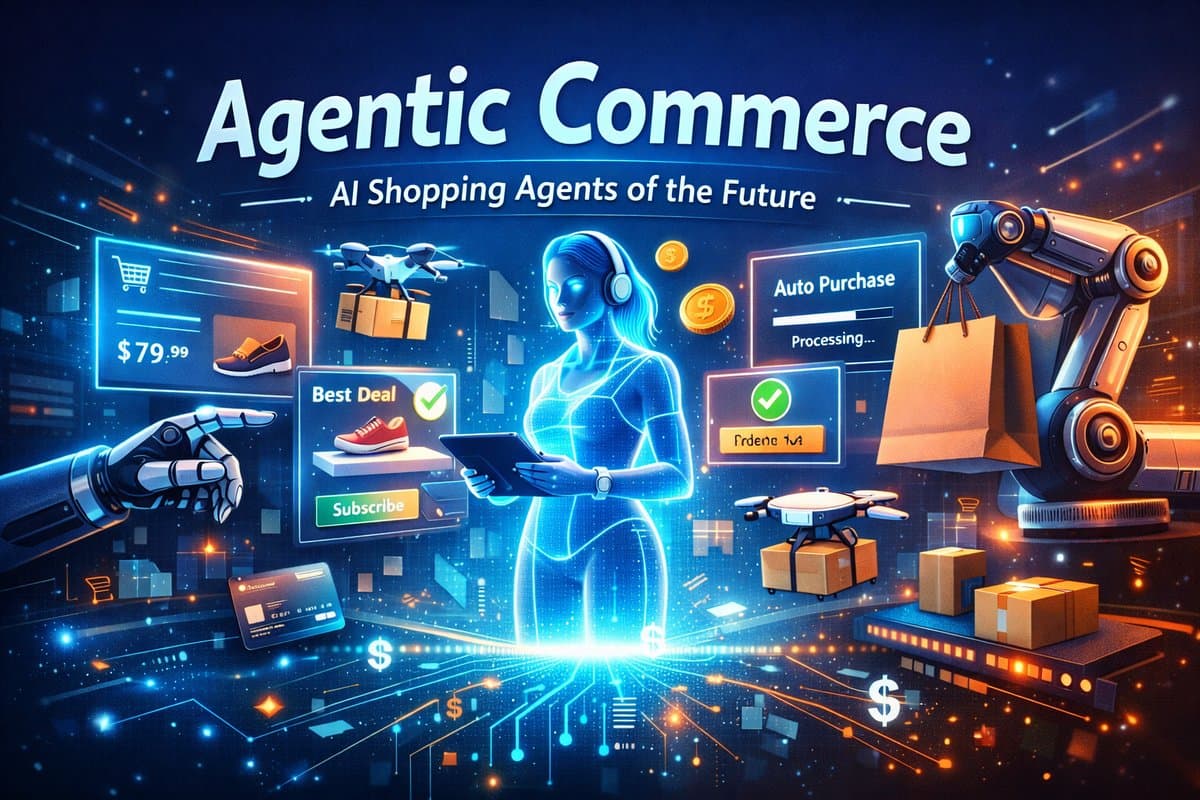
The Future of E-Commerce is Agentic
Agentic Commerce: The Next Frontier in Digital Commerce
The way we buy and sell online is shifting beneath our feet. What used to be a journey entirely guided by human interaction — search, compare, select, purchase — is now being reimagined through AI that acts autonomously on behalf of people and businesses. This emerging paradigm, known as agentic commerce, isn’t just incremental automation: it’s a structural change in how digital commerce will function in the coming decade.
What is Agentic Commerce?
At its core, agentic commerce describes a model in which AI agents independently execute commercial actions — from product discovery and comparison to decision-making and checkout — with limited or no real-time human involvement. This contrasts with traditional eCommerce and even AI-assisted shopping tools: in agentic commerce, AI doesn’t wait for commands — it takes initiative within defined user preferences and business rules. According to Mirakl, these are "advanced AI systems capable of understanding nuanced requirements, orchestrating multi-step tasks like negotiating terms and executing purchases."
These agents operate across digital touchpoints such as marketplaces, mobile apps, chat interfaces, and backend APIs, effectively acting as digital intermediaries that negotiate, transact, and fulfil on behalf of the user.
Why Agentic Commerce Matters Today
Several major technology companies and industry initiatives signal that agentic commerce is no longer futuristic:
Mastercard (as reported by Axios) is actively shaping standards for AI-driven commerce, focusing on trust, identity protection, and secure machine-initiated payments.
Google Cloud is championing autonomous, personalized shopping experiences that transform passive browsing into active agent-driven journeys.
Retail and commerce platforms are developing dedicated protocols and infrastructure, from the Universal Commerce Protocol to API-centric agent frameworks, enabling interoperability between agents and merchants.
Marketing analysts predict a broader shift in how brands operate, with autonomous AI agents redefining performance metrics, pricing incentives, and even marketing ownership. (cf. this article from BrandEquity)
Together, these developments show that agentic commerce isn’t an academic curiosity — it’s a practical, investment-backed transition in how digital markets function.
How Agentic Commerce Works
Agentic commerce blends several AI and digital-commerce disciplines:
1. Autonomous Agents with Context and Memory
Unlike basic chatbots or recommendation engines, agentic commerce agents can carry context across interactions. They understand user preferences, negotiate outcomes, and learn over time, making decisions that reflect strategic intent.
2. Structured Data & API-First Commerce
AI agents thrive when product information is organized, accessible, and machine-readable. Merchants must optimize metadata, prices, availability, and API access so that agents can discover and act on the best options.
3. Payment & Risk Infrastructure
For agents to complete purchases autonomously, commerce systems must support secure, automated payments, tokenization, and continuous risk monitoring — a non-trivial evolution of how eCommerce works today.
4. Buyer and Merchant Agent Interactions
In the full vision of agentic commerce, your shopping agent and merchant agents might negotiate directly, submit bids, or collaborate to fulfil enterprise procurement tasks — moving commerce toward agent-to-agent negotiation models.
Business Implications: Opportunities and Challenges
Opportunities
Hyper-personalization at Scale: AI agents can tailor recommendations and purchasing decisions to individual needs without manual browsing.
Efficiency Gains: Routine workflows — from reordering supplies to complex procurement — can be automated, freeing human teams for strategy.
New Revenue Models: Retailers and platforms can design agent-centric pricing, superscription -based purchasing, and loyalty mechanisms tailored to autonomous workflows.
Challenges
Trust & Regulation: Consumers and regulators are still determining how to authorize and govern autonomous purchasing actions. Crowe says that "regulators and compliance frameworks might not be ready" for these rapid changes.
Data Readiness: Many merchants are unprepared to expose structured data that agents can reliably act on.
Security & Risk: Automated payments and decision authority raise new questions around authorization, fraud, and dispute resolution.
What Comes Next
Agentic commerce is still early in adoption, but momentum is real. Analysts expect these systems to grow from pilot phases to everyday commerce channels by the late 2020s, reshaping both B2C and B2B markets.
For businesses, preparation means investing in AI-ready infrastructure, clean commerce data, API connectivity, and secure transaction systems. For innovators and service providers, it means designing trusted agent experiences that align human intent with autonomous execution.
Conclusion: Embracing the Agentic Future
Agentic commerce doesn’t replace human decision-making — it augments it by letting AI take ownership of routine and complex tasks alike. This transition stands to redefine digital commerce the way search engines transformed discovery: by shifting power toward automated systems capable of acting on our behalf.
As this trend accelerates, companies that build agent-compatible ecosystems and cultivate consumer trust will shape the next era of commerce — a world where AI doesn’t just assist, it transacts.
At Novique.ai, we’re watching this shift closely because it changes how automation should be designed:
Not as tools… but as trusted digital operators.
Ready to put AI to work in your business?
Book a free consultation to discuss how Novique can help automate and optimize your business processes.